

5 Ideas Changing My Perspective
A collection of things that I'm starting to look at differently.

Welcome! If you found this piece, or my recent posts 9 Frameworks Every Brand Builder Needs or Two Kinds of People to be useful, I invite you to become a free subscriber to get more of my articles on the intersection of strategy and culture.
This is a collection of reframes I’ve been holding in my head lately. Like everyone else, I’ve been thinking a lot about systems, obsessions and new realities. These are early thoughts and they will change, but today I want to share where some of my random ideas are leading.
1. We’re shopping for a new social contract.
People are moving out of the United States in huge numbers, so much so that nearly every single EU country is getting a record number of American arrivals. These are often people with children who are intentionally transplanting their families. Some cite cost of living, others cite active school shooter drills, quality of life, social benefits or sense of safety. And even though the number of American immigrants is at an all-time high, the trend has been increasing for years, so this isn’t merely a byproduct of today’s presidency.
You look at all of these reasons and they point to something my friend and community member Bia Assevero brilliantly pointed out - people are leaving for places that have clearer social contracts. It might not be a contract Americans are used to, but at least it’s a contract they can understand.
Amidst the chaos and erosion of American society, it’s increasingly difficult to know if hard work equals reward (see The Big Decoupling) or what citizens can demand of the state (see Repricing The Human Experience). Now, many have found they’d prefer to live some place where they know the rules of what is expected of them than to stay in a place where the agreement has become more opaque.
Peter Zeihan says healthy civilizations need “continuity: the idea that the positive things that make your life today possible - health, shelter, clean water, food, education, clothing, a functioning government, and so on - will still be around tomorrow […] Flip a switch and the lights will turn on. Each and every time.”
When we start to see this trend through the lens of a social contract instead of merely employment, education or lifestyle, we can suddenly see that maybe people are optimizing less for opportunity, and more for predictability.
The unspoken question beneath the American exodus is, What is a country for? The government doesn’t get to answer that question, the people do. And it’s apparent that people are starting to answer that question differently.
As concrete as American history might feel, we’ve cycled through at least four different social contracts in this country’s short life. Most recently we went from the stability promise of the 1930s to the promise of optionality of the 1970s. We’re outgrowing a post WWII contract predicated on the opportunity of “rags to riches” we see lionized in films and founder stories.
People are open to negotiating a new agreement, and for the time being, some are doing it with their feet.
2. Burdenmaxxing.
There’s an argument to be made that homesteading and agrihoods, two trends I have covered at length, are in some ways the offloading of burden from society to the individual. Yes they are powerful forms of control and resilience, but they are also the shifting of responsibility - of clean food, affordable living, nurturing environment - from the system to the person.
This kind of burdenmaxxing, where big looming problems are translated from a systemic issue to a personal one, is called ‘individualization of responsibility’. We all know how the carbon footprint shifted the onus of climate change from major corporations to individuals. And even though we understand the scam, I see people place more pressure on themselves to reuse their bags than they place on any corporate polluter to change how it operates.
Somewhere along the line, the mental trick behind the carbon footprint seeped into other parts of our lives that aren’t about saving the planet. It’s migrated from the margins of environmentalism to the very center of aspiration.
Moving abroad, buying vintage, eating nontoxic, hustle culture, homeschooling, nervous system regulation, living clean (really anything wellness) - somehow nearly every flex today is also the acceptance of undue labor, a way of taking on more work instead of expecting our systems and infrastructures do it for us.
It’s hard to name a modern virtue that isn’t burdenmaxxing in disguise.
We’ve accepted so many burdens in the past decade that we no longer recognize them as burdens at all. We experience them as identity.
3. Disaster comes with euphoria.
I’ve lived through multiple life-threatening natural disasters growing up in LA. Floods, wildfires, landslides. Every time I have one of those experiences, I remember the Will Durant quote, “Civilization exists by geological consent, subject to change without notice.” You don’t realize how unbearably fragile your physical world is until it rains one inch too many.
Disaster has brought me many confounding emotions, from shame that I would be so vulnerable, to fury that people can’t connect the fact that the climate change affecting my life is coming for them next.
But from disaster also springs euphoria, perhaps the most confounding emotion of them all. I’ve seen how it can bring communities together and make people the best version of themselves. When the world comes to a halt, a pure form of heroism arises within people. We suddenly have an immediate purpose in helping one another.
I’m reading Rebecca Solnit’s A Paradise Built In Hell for my book club, and she explores this phenomenon across multiple time periods and populations. In her work its clear to see that disaster suspends “reality”, and that’s just enough to remove the artifice of daily life. As she says, “If paradise now arises in hell, it’s because in suspension of the usual order and the failure of most systems, we are free to live and act another way.”
Disasters are portals. They give people permission to exist outside the rules of capitalism or career or age or anything else that limits their behavior. And in those moments, they overwhelmingly choose to be kind and generous. There’s a weird phenomenon where survivors actually miss something about the disaster years later. They have a nostalgia in their hearts for the weeks or months afterward when the community was self-directed in supporting one another, and everyone felt a deep sense of purpose and connection, even while standing in the wreckage.
This is what I come back to when I think about the kind of changes we’re living through. Change doesn’t necessarily mean disaster, but even when it does, the story we tell about human nature tends to be wrong. Sometimes people are their best in precisely those moments.
4. The pre-reality of fiction.
When you read fiction, do you witness the main character or do you become them?
I recently gave short interview to NPR about the real reason why romantasy is growing. I’ve written before about how it’s easy to treat the genre as escapism, but if you read these books the way millions of women are reading them right now, it becomes obvious they’re reading for something even more satisfying than sex: justice.
At a time when bodily autonomy and women’s rights are being threatened, our need for sexual expression and moral order do not go away. We just find new channels.
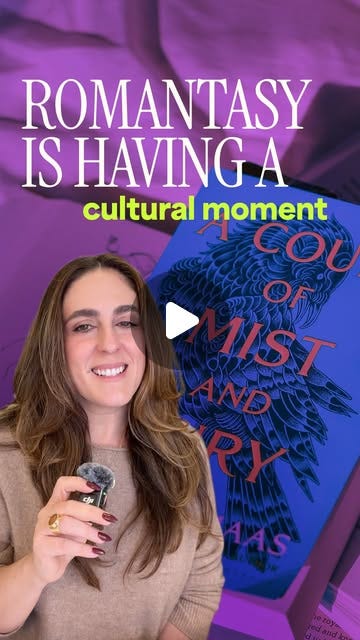
But there was another part of the interview that probably won’t make the cut, which I think is equally interesting.
There are generally two kinds of fiction readers: those who witness the main character in their mind’s eye, and those who experience the book by becoming the main character. They place themselves in the story and experience it as if they themselves are the center of the world.
Readers who become the character are able to relate so well that they can temporarily alter their self-concept. Some part of them becomes enmeshed with the character, and the way they think or feel about themselves in real life changes, too. At least momentarily.
And when millions of people rehearse the same unavailable selves, you get a population that has already lived a different life internally, and begins to measure outer reality against it. It’s a great example of how if you build in culture, you have to be mindful of which version of reality you’re tracking.
5. Thought-terminating diasporas.
If you’re confused about Iran, it’s likely because you hear one side of the diaspora shouting one thing, the other side shouting something else, and both sides telling you the other is the enemy.
I’ve stopped talking about Iran because I don’t know what to say anymore, or to put it more honestly, I don’t know what I’m allowed to say.
Our diaspora has invented a discourse around who is Iranian enough. Are you Iranian enough to have an opinion if you were born in the West? Are you Iranian enough to know what you’re talking about if you didn’t have family murdered in the protests? Are you Iranian enough if you look white? If you’re wealthy? If you have the wrong politics? If you don’t speak the language? If you’ve been away too long?
I suspect that anybody from any diaspora will know what I’m talking about. It is the cruelty of being told your tears are disingenuous. That you must cry alone because you are not the people you came from. And I can see clearly now that nobody escapes a country that forced them out without a deep trauma. It’s this deep, unresolved pain that makes the diaspora turn on each other.
It’s remarkable to me that the people of a diaspora silence each other, but they do. I’ve done it myself in the comments sections of random strangers. I know what a slippery slope it can be. We’re all so desperate to save the people back home that the people here can start to look like the enemy.
We use thought-terminating cliches, phrases that shut down critical discussion or analysis, just as any cult would. In my diaspora it sounds like “How much did the Iranian government pay you to say that?” or “Don’t talk about Iran from the comfort of your western lifestyle.”
When pain has nowhere to go, we stop seeing it for what it is. It becomes our truth and we start to build everything else around it. Not just in diasporas, but anywhere people are trying to make sense of something they can’t resolve.

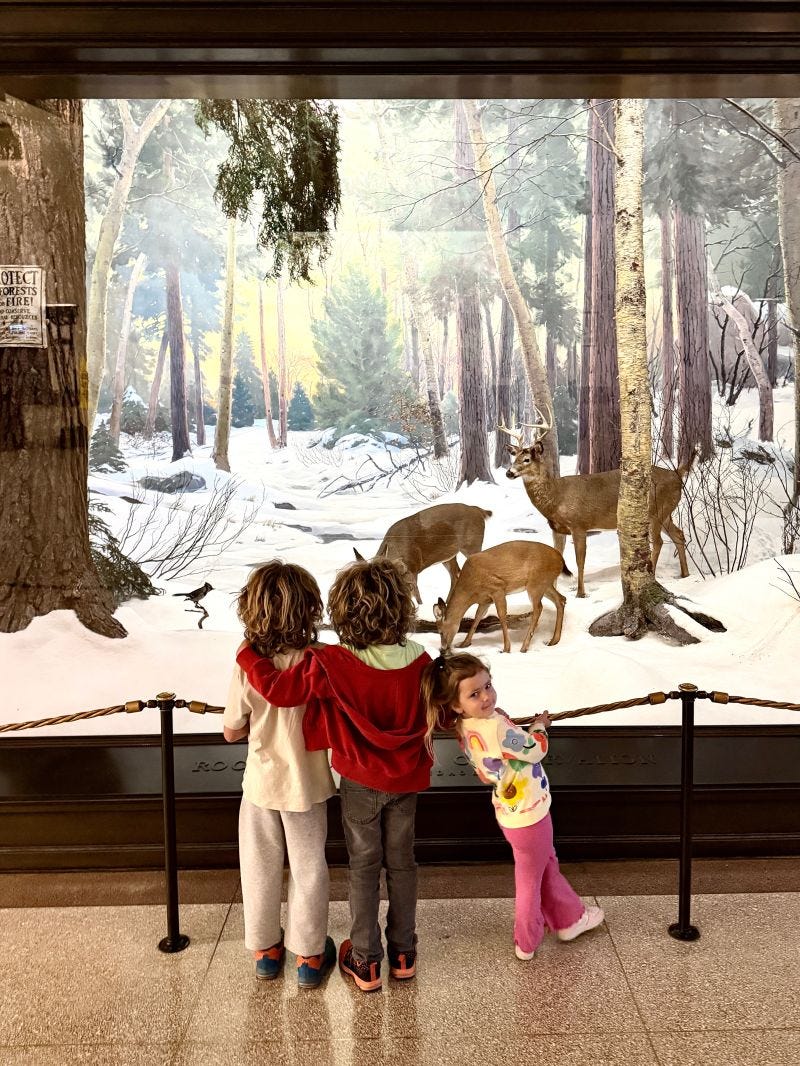
We landed in New York last week for our first Exposure Therapy dinner of 2026, and one of my joys in this job that we’ve created for ourselves is being able to bring my children on these trips (here, at the Natural History Museum).
In our category, and especially as an entrepreneur, you have many seasons in life. Some seasons are slow and beautiful, while other seasons accelerate you in thrilling ways. Sometimes you don’t know how the different parts of yourself are going to converge. What it really feels like is a sudden splitting of yourself into multiple pieces that feel like they’re all going in different directions, but then somehow they all come to the same place but in a totally new territory.
I’ve gone through this kind of evolution with my team multiple times and at this point, we know how to trust it. But what is most beautiful about where we’re at now is that it hold so much more room for connection and community and even family.
I think we all pay a lot of attention to how the world of work is changing, but each one of us is a microcosm of that change, too. We can look to ourselves to see a small reflection of what is happening around us. As wild as it all is, it’s also widening to hold bigger and bigger parts of ourselves. I can see that in my friends and colleagues and the audience research we do. You’ve probably done it in your own way. Work is broken is may ways, yes, but the edges of work are also softening.
Yours,

Hi, I’m Jasmine Bina. I’m a brand strategist and cultural futurist.
If you love this newsletter and need more:
My private brand strategy community Exposure Therapy
My agency Concept Bureau
The great displacements are always socio economic and we're seeing both of them now (within and out of the US) and, yes, people are leaving the US but I sense that people are rethinking North America, even Canada, because something has gone wrong. It's just more obvious in the US and, of course, louder. Add climate to this equation, and people from "stable" countries are going to be on the move a lot.
Last night I took my kids to see “the magic faraway tree” and was really blown away at the new ideologies placed in front of us, in film. All the things you speak about here, burdenmaxxing, disaster, new social contracts… the power of film will confirm these ideas as realities for our kids, and the child within us.